Showing posts with label Comic Review. Show all posts

6/07/2015

Review: A-Force #1 (Or: A Lament On The Current State of Comic Books)

Ah, Secret Wars... Marvel's latest "Earth-Shattering Event" has certainly kicked off with much fanfare. One of the benefits of Secret Wars is that it's paving the way for a number of new series allowing an array of talented writers and artists to go in directions that were previously unheard of. Here we have A-Force written by Marguerite Bennett and G. Willow Wilson with pencils by Jorge Molina. A-Force features a line up of recognizable super heroines tasked with protecting the island of Arcadia.

Does any of this make sense? Good, then you're just as lost as me.

 Let me just start with saying that I love the concept. A-Force has a strong cast of interesting women with many characters that haven't been given the chance to shine because they've taken a back seat to the men, or just outright ignored. The series stars a few high-profile heroines like She-Hulk (acting as the Baroness of Arcadia) and Captain Marvel, but also manages to give some face time to lesser knowns, like Sister Grimm from Runaways and Young Avengers' Ms. America.

The premiere issue focuses on Ms. America's impetuousness and gives readers a taste of the rules and laws of the domains of Battleworld. When Ms. America breaks one of the immutable laws, she is banished from Arcadia despite She-Hulks protests. It's a simple enough premise for a 22-page story and works well to introduce readers to the layout of the universe. That doesn't make it easy to follow for casual comic readers.

The problem A-Force faces is not the same as most new series, being mired in continuity that new readers have a hard time to keep up. In actuality, the problem is that it's mired in an all new continuity, making it difficult for long time readers to keep up. Well, I shouldn't say "long time" as I have a feeling those that have been following the latest Secret Wars titles would be able to understand the back-story of A-Force. Even new readers who make this their first title would be able to keep up, their lack of comic history being to their benefit. But fans like me who have had to pare down their comic reading in recent years due to financial restrictions would have a hard time with this new direction, mostly because it features familiar characters in very different incarnations.

Take, for example, the two male characters that show up in A-Force. The first is Falcon. But not my Falcon. This one is imbued with the power of Thor, looking more like a Hawkman knock-off that the new Captain America. Then there's Doctor Strange, who appears as an emissary for Doctor Doom, the overlord of Battleworld, who imposes the ruler's laws on the island of Arcadia and its inhabitants. These are two characters that I know fairly well, but I spent way too much time wondering what the fuck was happening that it impeded my appreciation of the book.

I assume that these are versions of characters that I'm familiar with from a different continuity. So...how much effort do I need to put into Secret Wars for this to make sense? Will all of this be explained in A-Force or do I need to follow multiple series? Which ones? Do I have to abandon my dreams of retirement in order to give Marvel every last penny I've earned just to have my questions answered? Who the fuck knows?

But do I hold the writers responsible for this? Nope. I'm well aware that all of this is because of Secret Wars, in which Marvel takes multiple lines of continuity, from the regular line up of books that he been in print since 1962, to the Ultimate Universe that has been around since 2000, to the animated X-Men series from the early 90s, crumpled them all up together to create one massive new world for fans. Criticized for being a reboot, Marvel is calling this stunt a "reset", but I don't see much difference. They're taking decades of continuity and sending it on its head to see what sticks.

I...probably sound bitter over the move. I'm not. It's a hell of a bold move on Marvel's part to condense their different continuities into one easy-to-follow bundle. It's just kind of a shame that it came three years following DC Comics' same initiative, "The New 52".

Unfortunately, there isn't much else to say about the first issue of A-Force. While I like the few characters Bennett and Wilson have chosen for the line up, the action was rushed. The entire issue felt like a very tiny cog in an over-large machine. Sure, it may be integral to the way the Secret Wars universe works, but that's not obvious from this. I'm definitely interested in seeing how the events play out, as well as the additional characterization we're destined to get but for now, this just boils down to another tie-in. With that said, I will continue to pick up A-Force just to see where the story goes (and hopefully have some light shed on this whole "Falcon" thing).

2/16/2014

Comic Review: Ms. Marvel #1

Back in November, the news that Marvel would be unveiling a new Ms. Marvel was huge, being revealed by the New York Times before blowing up across all aspects of social media. And I will admit, it was pretty important; the new Ms. Marvel would be a 16 year Muslim girl from Jersey City. Now, I'll easily admit that I was worried at first because the only aspect of the character that was being focused on were that she was Muslim. The news stories didn't mention anything else about her (except for the New Jersey thing). I could see why Marvel would attempt to open up the doors of diversity and create a new character that actually exemplifies the world around us. But if all the girl had to offer was her religion, she would just be a two-dimensional caricature, falling short of actually being someone.

I pushed that to the side and sent a tweet to my buddy Jay over at The Sexy Armpit. A new super hero from New Jersey was definitely in his wheelhouse and I wanted to make sure he knew about it. After a short conversation, he convinced me that I was "The Marvel Guy" and that I should be the one to cover it. I quickly agreed with him and, well, here we are.

The first issue is pretty much at the "getting to know you" stage, introducing Kamala Khan, an intelligent and well spoken 16-year-old girl. She comes from a stable household, lives in Jersey City and has a handful of good friends. She also dreams of becoming a super hero and writes popular Avengers fan-fiction for the internet. All in all, she's a regular Aughts child. One night, after leaving a party she sneaked out to attend, she is engulfed by a strange fog and has an enlightening conversation with Captain Marvel, Iron Man and Captain America. When she wakes up, she finds herself transformed.

For a start-up issue, Ms. Marvel was pretty stellar. Seeing as we're getting a new character in I don't know how long, the issue takes its time with introducing the cast to us. This isn't a "Here's Peter Parker; now he fights the Lizard" kind of thing. The issue can't take for granted that the reader has some kind of knowledge of who the main character is. Which is why it's acceptable for it to end with the reader seeing the hero in costume for the first time. It's a great build up to the cliff-hanger of an ending.

The issue was written by G. Willow Wilson, an award-winning writer and essayist who also happens to be a Muslim woman from New Jersey, so I guess there really is no one better to write a character like that than her. One of my biggest fears of the title, given the way Marvel was promoting it, was that Kamala's religion would be the focal point of her character. As someone who lacks a belief in organized religion, this wasn't something that appealed to me; while I think religion is OK as a moral compass, I don't think it should define a person. In a way, my fears were realized, but not in the way that I imagined. Kamala adheres to her religious doctrine, such as not eating pork, but she doesn't necessarily see the importance of it. In fact, in some cases, she rebels against it. To her, being a Muslim isn't her defining quality and most of the allusions to Kamala's religion are made from outside forces, like her father and the bitchy white girl from her school.

We also see that, while Kamala rages against the rules of her family, her father has taken a lax approach to much of his Muslim ideals. He mocks Kamala's brother's prayers, stating that if he prayed less, he'd have more time for find a job. Meanwhile, her brother, Aamir, fires back that he refuses to profit from usury, a jab at his father's job with the bank. So even in this small familial setting there are varying levels of religious adherence. We can see how Kamala developed her rebellious attitude. In her own words, she's "from here" and she just wants to experience life as a "normal" person.

Variant cover by Arthur Adams
Artist Adrian Alphona has a pretty distinct style and he makes it work in Ms. Marvel. The detail he puts in Kamala is remarkable, and is emphasized by the way he caricatures the supporting cast. Kamala's father is pictured as round and dumpy, with a big nose and loose jowls. Zoe Zimmer, the popular blonde at school, is long and lanky, her face lacking any defining features. Her boyfriend is shown like a football meathead, with a broad torso, thick neck, and big ears. Alphona's storytelling style is also simple yet just as effective. He chooses to view the action mostly head on, rarely varying his angles. But he adds small dynamic touches by subtly changing his view or tilting a panel slightly. It simplifies the read, making the action easy to follow. Alphona was a great choice for the book.

Though hesitant at first, I am pleased with the final product of Ms. Marvel #1. Wilson and Alphona make a great team and have introduced readers to a spectacular character. Kamala Khan has the ambition and energy to step into the role as Ms Marvel, and I'm especially proud to see a new heroine from New Jersey. My little home state doesn't get enough attention so anything that shares it in a good light is OK by me. I look forward to seeing what Wilson and Alphona have in store and will be heading out to the comic shop more often than I have been recently.

2/11/2014

Comic Review: Black Widow #1

I picked up the first issue of Black Widow when I was at the comic shop last month mostly on a whim. Having missed out on the newest Hawkeye series that everyone is buzzing about, I didn't want to be left in the dust with the other half of the Avengers super spy team. And even though I was looking forward to reading it, it sat on my side table for a few weeks untouched. I finally got around to checking it out and decided to share my thoughts with you all, despite issue 3 hitting stores this past Wednesday.

The story starts en media res with a suicide bomber being talked down by a mysterious Russian woman who promptly delivers him to the authorities. It turns out that Black Widow is taking jobs on the side of her time with the Avengers. Paid wetworks jobs. The kind of thing a mercenary would do. While this clashes with what readers believe of Widow, her intentions behind them make sense.

Nathan Edmondson scripted the book and while I'm not familiar with some of his other work (The Activity, Who Is Jake Ellis), I love how he handles Black Widow. She's looking to atone for the sins of her past, to make up for all the bad shit she's done. And the jobs she's taking? She chooses them by how bad her target is and how many lives they've destroyed. Black Widow has essentially been reimagined as Dexter, where she hurts only those that hurt others. It's a nice twist on the character, one that definitely works. It manages to bring her back into the fold of work-for-hire mercenary but keeps her likable to the readers and doesn't conflict with the overall mission of the Avengers.

Phil Noto's artwork is simply amazing. He manages to imbue a feeling of phot-realism into his characters even though his art is heavily influenced by a watercolor style. Noto excels at emotion, as well. He masterfully conveys Widow's expressions, making her emotional state easy to read. This isn't a simple task; many artists attempt to do this but fail, making the characters look like they're at the climax of a porn film. But Noto gives Widow so much depth that she comes off beautifully on the page.

Also, I like how Noto chose to give Widow a subdued wardrobe. In these times of "sex sells" where our comic heroines are wearing ridiculously skimpy outfits to help drive numbers, Noto takes the opposite route. His Widow is zipped to the neck, without a inch of cleavage unnecessarily exposed yet she still manages to come off as the sexy super-spy that she's grown into. Maybe it's just the female empowerment that makes her so attractive but regardless, Noto proves that "slutty" does not equal "sexy".

I wasn't expecting to enjoy this title as much as I did. Black Widow has always been a convincing supporting character but as stand-alone star has always seemed to fall flat. I now see that that is not due to the character herself but how the writer handled her. With the success of The Avengers, Marvel is making the right move to shine the spotlight on some of the film's secondary cast, like Hawkeye and Widow. Now if only they could take the risk on giving them their own movie franchises, I'd be all set.

2/07/2014

Comic Review: X-Factor #1

Marvel is in the habit of recycling old comic titles, probably in an effort to grasp the popularity that a particular title once had. This rule especially applies in the case of the X-Men and their numerous offshoots. X-Force, for example, was recently reintroduced as a Cyclops-condoned wetworks team with some of the X-Men's most vicious members before evolving into something...different starring the likes of Deadpool and Fantomex. I've never read the newer issues, like Uncanny X-Force (Marvel likes reusing adjectives as well) so I'm not too sure what the heck is going on there.

The newest title being reimagined is X-Factor, a team that was created by the five original X-Men and more recently became a Jamie Maddrox-led private investigation team that included Siryn, Shatterstar, and M. The newest incarnation of X-Factor, the All New X-Factor, features a shake-up of the cast, bringing some different mutants into the fray. I'll get to that in a moment.

The book opens with a pair of scientists heartlessly torturing a shadowy figure before quickly moving on to a scene starring Gambit, the X-Men's resident thief, in the middle of a heist. He is interrupted by Wolverine who is annoyed with Gambit for shirking his responsibilities at the Jean Grey School. The irony (or should I say hypocrisy) of someone like Wolverine chastising Gambit for his thieving ways was most definitely not lost on me. But, whatever, I guess. The story needed an inciting incident to get Gambit into a bar and this was it.

While in that bar, he is approached by Polaris, the mutant daughter of Magneto. They exchange banter worthy of a Gilmore Girls script for a few minutes before she convinces Gambit to join her on a trip to the headquarters of Serval Industries. Serval is "a rising corporation" with their hands in everything from online search engines to weapons manufacturing. But above all, they are in the business of philanthropy. They also have enemies, as evidenced by the missile attack as Polaris and Gambit are en route to their destination. It sounds more serious than it actually is as the attack is thwarted in the span of two panels.

Gambit is introduced to Harrison Snow, the CEO and President of Serval. Snow explains that he wishes to revive X-Factor as a corporate-led super team. At this point, Quicksilver is brought in as the third member of the team before they are quickly dispatched to rescue a kidnapped mutant who is being tortured for scientific research. Thus the issue comes full circle to the first scene.

There were quite a few things that bothered me in the issue, most of which I already snarked about above. The Wolverine scene was head-shakingly annoying with the way he barges in on Gambit with some vague excuses of "the owner turned it [the security system] off once I arrived". Their entire exchange was just a ridiculous mess as they discuss the dangerous magical artifact that Gambit is trying to steal. But it's OK because, as Wolverine tells us, "the spells that activate it have been lost for three thousand years". Clearly the issue's writer Peter David just needed an excuse to get these two into a room together without making Gambit look like a thieving dick.

Then there's the bar scene. Gambit sits drinking among a pair of unconscious men and a smoldering crater in the floor. Apparently they've angered him with their opinion that New Orleans deserved to get hit by Hurricane Katrina. This is all explained through a clumsy info-dump by Gambit who goes on to explain the oh-so-timely discussion of the matter. Yes, Hurricane Katrina hit almost a decade ago but it's still a hot topic because "we got a long memory". A scene like this could have come about in any number of ways, but again, those ways would have made Gambit, the main character and protagonist of the book, look like a jerk. Like an anti-hero, and that's clearly not what David was going for.

But here's the thing; when the scenes you write to make your hero look heroic come off as forced and ridiculous, maybe that character just isn't a hero. Gambit is a thief. He has been since the beginning. He's also kind of a jerk. That's actually why he became such a popular character to start with. The same way that Wolverine and his murderous berserker rages made him one of Marvel's cash cows. He is more likely to steal a diamond-and-emerald-encrusted pendant for the high dollar value it contains than a magic artifact that may wind up in the wrong hands. And though, yes, he would defend New Orleans if he encountered someone talking shit about the city, he would just as likely get into a bar fight with a guy he tried to hustle playing pool. And the latter would seem less contrived and more believable.

Pretty much what I'm saying is Gambit isn't right for this book. Polaris and Quicksilver both take a back seat to Gambit as he meanders his way through becoming a member of a new X-Team so it's difficult to say how their inclusion will affect the book. But Gambit, or I should say David's vision of Gambit as a righteous hero, really dulls it and makes the title laughable.

The art took my by surprise. At first I wasn't crazy for Carmine Di Giandomenico's pencils; they seemed too rigid for me, lacking life. But as the issue progress, his style grew on me and I could see the appreciation he had for the character details. He managed to make Gambit's face less punchable and put a certain smugness on Polaris. Although Polaris' permanent wedgie was a bit unnerving.

More than the pencils, I really have to tip my hat to the colors. It took me a while to see the theme but colorist Lee Loughridge did a beautiful job of maintaining specific color palettes for certain scenes. In the earlier pages, Gambit is shrouded in purple with Wolverine in blue. Later, Gambit's color palette switches to yellow, the color that encompasses most of X-Factor, signifying his acceptance of the team. The one exception is Quicksilver, who maintains the color blue, perhaps indicating that he is not entirely a team player, like maybe a traitor or a spy. No matter how this plays out, it was a nice touch by Loughridge.

I've been a fan of X-Factor in the past so I was looking forward to this new incarnation of the team. And while I can enjoy most of what's going on, I just can't get past this forced re-characterization of Gambit. I've never really liked the character but he does play well into certain situations...given his rapscallion ways. And even though he has the heart of a hero, he is not as virtuous as David is trying to portray him here. Because of this, I doubt that this All New X-Factor is for me.

1/20/2014

Comic Review: Avengers World #1

It's been about a year since I read comic books on the regular. During that time, Marvel was my thing. I started to get into DC Comics after the New 52 began but for years, I followed Marvel religiously with X-Men and Spider-Man being my main focus. It really wasn't until the first New Avengers series hit the stands did I begin to follow the Avengers but when I started getting into it, I really enjoyed it. So to hear that a new Avengers series was coming out, Avengers World, made me really excited, enough so to pick up the first issue. To see Jonathan Hickman's name attached to it (where he shares writing credit with Nick Spencer), the guy that has been touted as one of Marvel's architects, was definitely a good sign as well.

After reading the issue, however, I was a little disappointed. Not disappointed that it was bad but disappointed that I'd read it already.

The issue focuses on Captain America and S.H.I.E.L.D. director Maria Hill. They stand on the bridge of a S.H.I.E.L.D. Helicarrier as Hill briefs Cap about a few goings on in the world. It seems that a few rather serious events are happening concurrently across the globe and different teams of Avengers have been dispatched to investigate. Thor, Captain Marvel and Hyperion are looking into a rash of unnatural natural events on the eastern seaboard. Wolverine, Black Widow, Falcon, and Shang-Chi are in the middle of national riots in Madripoor. Hawkeye, Spider-Woman, Nightmask, and Starbrand are in Italy investigating a strange artifact. Smasher, Sunspot, and Cannonball are sent to A.I.M. Island. At first glance, all of these events seem to be unrelated, but if that were the case this would be a very uninteresting comic.

My problem with this issue is that it brings to mind Ultimate Comics Ultimates #1, written by Hickman back in 2011. The events portrayed in that issue were much different than here, but the delivery is the same: Nick Fury on the bridge looking down at different world events as separate teams of heroes look toward a resolution. Both issues start and end the same as well, with the threat of a great, all powerful evil looming in the distance, ready to strike.

Again, that doesn't make Avengers World bad. It just feels like recycled material.

I do have an issue with the characters in the book. The Avengers have always had a revolving door of members, with a few heroes making short appearances to never be seen again. But some of the heroes that the new team features, like Starbrand, Nightmask, and Smasher, are completely unknown to me. Like I said, it's been a while since I was reading the Avengers religiously so I don't know if these characters came up to prominence recently, but they seem like odd choices to add to a battle-hardened team like the Avengers. Even the inclusion of ex-New Mutants Sunspot and Cannonball had me scratching my head. I mean, I can accept it but these aren't the faces I'd expect to see.

One aspect that makes the issue shine is the art. Stefano Caselli's pencils are simply amazing. He illustrates his characters so that their movements come off as natural, not stunted and confused like a lot of other artists. But more than that, he has a great eye for panel composition, varying his structure from page to page. The movement makes the book come off more like a movie that a comic book, which is what makes it so exciting. And colorist Frank Martin adds tremendous depth to the pencils, using perfect shading and highlights throughout. The pairing is brilliant and really creates the strength of the title.

Even though it would seem like I was trashing the first issue, I wasn't. I was disappointed, without a doubt, but it was still a really fun read. Despite the narrative being a rehash of Hickman's past, the story itself was original. However, if it turns out that the big baddie out to take over the world is a one-time ally of the Avengers twisted by his own power and intelligence like it was in Ultimate Comics Ultimates, then I may have to officially give up on the man. But let's hope it doesn't come to that.

1/16/2014

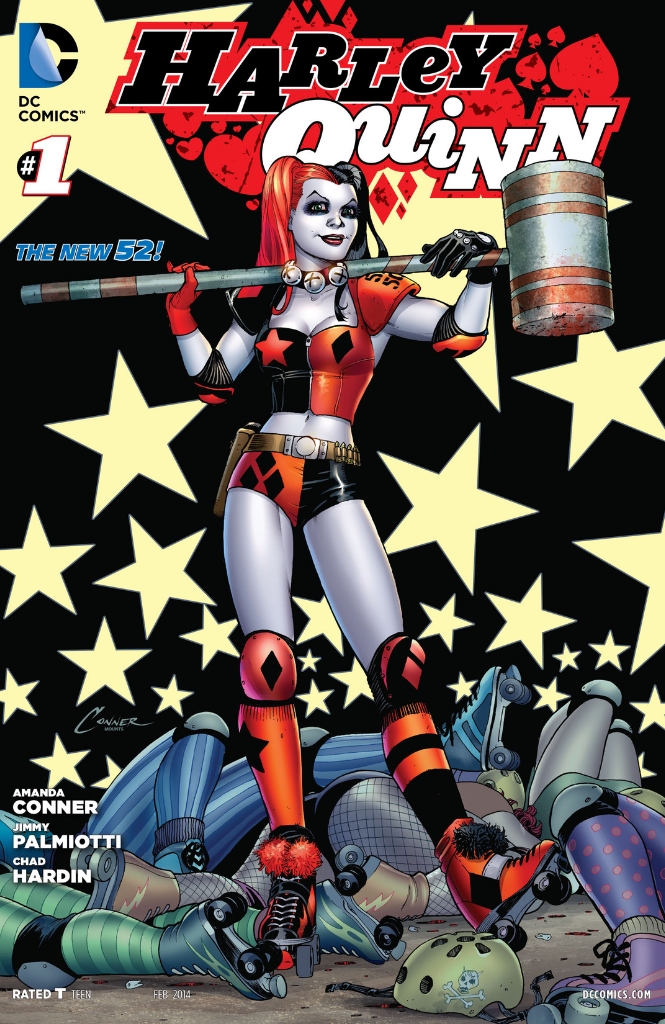
Comic Review: Harley Quinn #1

Despite the controversy surrounding the art contest for Harley Quinn #0 back in September, DC Comics pushed forward with the series, which makes sense considering they had already invested in it. Even though I didn't get the Number Zero (after flipping through it in the store it had nothing that appealed to me) I did pick up the first issue. I might be a few weeks late with my review but I wanted to weigh in on what I thought.

The issue finds Harley zipping down the highway on her motorcycle headed toward a new life. She's been left in the dust by "Mr. J" and has been willed a place to stay by a former patient of hers from back in her life as psychiatrist Harleen Quinzel. But her new place isn't what she imagined and she's forced to seek...gasp...regular employment!

The entire issue is used as a way to showcase Harley living a, somewhat, normal existence. This doesn't focus on her life with the Suicide Squad or her time as the Joker's moll. No, Harley finally gets her chance to be her own person, even if that means getting two jobs to afford her new home. But it's not all real life boredom; it appears that people are out to get her and collect the bounty on her head. So there is some action.

When I first saw Amanda Conner attached to the issue, I assumed it was as the issue's artist but in actuality, she shares the writing duties with Jimmy Palmiotti. (Amanda is the cover artist, however.) For the most part, I liked the first issue; it was cleverly written and managed to show a more human side to Harley Quinn. Granted, she's still completely out of her gourd, but that really brings out more of the humor of the book; by juxtaposing the insanity next to the normalcy, it makes the insanity that much funnier, such as her nuclear meltdown when she sees a weiner dog being mishandled by its owner. This shows the reader that Harley has the semblance of a heart and conscience, just not when it comes to people.

What I didn't get, though, was the running gag with the beaver. Maybe it's because I haven't been following the character so closely since the New 52 started so I don't know if it's a roll over from previous comics or not but it was weird. I'm still up in the air of whether I like the joke as it made her come off too much like Marvel's Deadpool, a character I'm not too keen on. If that was the intention, then it's pretty ironic since Deadpool is just a cheap knock-off of another DC character, Deathstroke.

The art chores were handled by Chad Hardin and he brings great life to the pages. Hardin's panels are chock full of details, many of which help to emphasize the off-the-cuff characterization Conner and Palmiotti are trying to portray, like her odd record collection which includes "Sweating to Gangsta Rap" and "Polka Madness". He also manages to illustrate the depth of New York City, as evident in the way he draws the buildings and street views. But Hardin really shines in his detail of Harley, bringing so much emotion to her face. That coupled with Alex Sinclair's colors makes her eyes sparkle in a few panels.

A few things I noticed as I was reading the issue: firstly, I am happy that the book was able to rise above the controversy over the art contest. The idea of showcasing Harley committing suicide may have seemed clever and "keeping with the spirit of the character", but just came off as silly and desperate. Hopefully the memory won't tar the actual spirit of the character. And secondly, every time I read Harley's dialogue, all I can hear is Arleen Sorkin's voice. I don't know if that speaks towards the idea of Harley Quinn or the lasting effect that Batman: The Animated Series has had on me but either way, it helped to make me enjoy the book even more.

1/10/2014

Comic Review: Detective Comics #27

Greg Capullo cover
Ever since the launch of the New 52, DC Comics has been in the position to do something special for their co-flagship character, Batman. Having made his first appearance in Detective Comics #27 back in 1939 from the team of Bob Kane and Bob Finger, Batman has been one of the most popular comic book characters in the world. So popular, in fact, that the Detective Comics title had been running for 881 consecutive issues. But with DC's universe wide relaunch and renumbering, a new Detective Comics #27 was just around the corner. Thankfully, the company took the opportunity as it presented itself and used the issue as a way to celebrate the Caped Crusader's 75th anniversary.

The newest Detective Comics #27 is an oversized issue featuring an oversized line-up of fantastic creators. From Neal Adams to Scott Snyder, Francesco Francavilla to Jim Lee, the issue is chock-full of Batman-y goodness. I first caught whiff of the book when my wife and I met Brad Meltzer at a book signing back in October where he revealed that he was contributing to the Batman mythos. Since then, I've been looking forward to this to come out.

Jim Lee cover
The book is broken up into seven different stories, most of which celebrate the history of the Batman. The second story in the issue (I'll come back to the first), "Old School", was written by Gregg Hurwitz and drawn by Neal Adams. It takes the reader through the gamut of Batman incarnations, from the hokey jokester of the 60s, to the dark and gritty version of the 90s, quickly racing through the years showing how Batman has been forced to evolve to stay interesting and relevant. The art itself also shows the progression. The opening panels imitate the splotchiness of early comics printing and gradually shifts through styles to the more sophisticated coloring of today. It's a beautiful story and fun as hell.

Peter J. Tomasi tells a tale of the future in "Better Days", where an elderly Bruce Wayne celebrates his seventy-fifth birthday. It features the aging cast of the Bat-family, Dick Grayson, Barbara Gordon, Alfred, even Damian Wayne, all on the verge of osteoporosis themselves.The art by Ian Bertram pays homage to Frank Miller's classic The Dark Knight Returns, with his heavy-bodied Batman and overly wrinkled Bruce Wayne. Even his depiction of Barbara Gordon brought to mind Carrie Kelly, the Robin from Miller's story. It's a great story that looks forward instead of backward and captures the spirit of how deep the need to be Batman goes to the core of his character.

Frank Miller cover
Francesco Francavilla takes a different approach to the idea of Batman in his tale, "Hero". Whereas Batman is usually immortalized in a battle with any of his Rogues Gallery, also seeming to fight the forces of evil, "Hero" shows him rescuing a family after a terrible car accident. In the span of four pages, Francavilla shows that being a hero is more than just bashing in the Joker's face. Batman's contribution to the city of Gotham goes much further than that.

"The Sacrifice" by Mike Barr with art by Guillem March, explores what would have happened had Bruce Wayne's parents survived the attack outside the movie theater on that faithful night. With the help of the Phantom Stranger, Bruce gets to see his life had his parents lived, one in which Gotham is overrun by criminals and many of Batman's friends and allies meet with terrible situations. It shows the heavy-handed necessity of the Batman, a being dedicated to keeping the city, and the world, safe from harm, despite the sacrifice that's asked of him. It's a touching tale, one that's reminiscent of Marvel's "Age of Apocalypse", where one small change, the loss of Charles Xavier, can have wide-ranging consequences.

Chris Burnham cover
The first chapter of "Gothopia", a multi-part story written by John Layman, appears in this issue. In it, Gotham has become a crime-free utopia, basically what would happen if Batman succeeded in his fight against crime. But that peace is thrown out of whack when Poison Ivy shows up and makes Batman start to question his reality. It's an interesting story, the longest of the book, and probably the only one that fits into the current continuity. The art, by Jason Fabok, is gorgeous, telling a sophisticated story through a wide range of beautifully drawn panels. Fabok's emotion is spot-on, his story-telling crisp, and his characters exciting. The pairing of the story and the art make this one of my favorite stories in the book, and also one of my favorite recent Batman stories.

Scott Snyder has been lauded for his portrayal of Batman in the Batman series and he hits a home run here with"Twenty-Seven". Another vision of the future, Snyder takes Batman 200 years into the future, with the Dark Knight discovering a way to ensure that his legacy lives on to protect Gotham City. Sean Murphy lends his artistic talents to this story, bringing to life a variety of twisted versions of the future. It's a nice way to wrap up the issue, by promising fans that the idea of Batman will continue, even long after the person known as Bruce Wayne is gone.

Tony Daniel cover
Even though "Twenty-Seven" closed the book, I wanted to save my favorite story for last. Author Brad Meltzer returns to comics with "The Case of the Chemical Syndicate", a re-telling of Batman's first adventure. The story offers two narrations, one being Batman's internal dialogue, the other a journal entry of "the Bat-Man" explaining why he does what he does. Meltzer delves into Batman's convictions and explains his reasons for crime fighting, for putting himself in danger every night. Some of his reasons are admittedly selfish, while others are part of the self-less nature we know. Meltzer's story is brought to life through the pencils of Bryan Hitch. Unfortunately, the art lacks when compared to a lot of Hitch's past works, but it's still lively and fun to look at.

Without a doubt, Detective Comics #27 is a fitting tribute to one of the world's most popular characters. Though it comes with a hefty cover price, clocking in at $7.99, DC manages to add a lot of value with seven wonderfully touching stories. They also did away with most of the advertisements, filling the additional space with pin-ups from a range of artists. Nowadays, most everything is touted as a "Collector's Item", but Detective Comics #27 is truly something that most people would want to keep, it's just that well made.

12/23/2013

Comic Review: Krampus

With Christmas right around the corner, I'm doing quite a few things to get into the holiday spirit; watching Christmas movies, basking in the glow of colorfully decorated houses and eating as many freshly baked goodies as I can find. Sadly, I'm not able to enjoy comic books as much during this time of the year, mostly because you don't see many Christmas-themed comic stories. At least not in the same vein as prime-time television shows.

But that's not to say Christmas comics don't exist. In fact, Image Comics is getting into the holiday spirit with their recent release of Krampus, written by Brian Joines and drawn by Dean Kotz. In it, the Secret Society of Santa Clauses discovers that little by little, their magic is fading, preventing them from completing their preparation for Christmas. To combat this, they turn to a great creature that has been imprisoned for years, a creature that they are unsure they can even trust: The Krampus. Striking a deal, the Krampus goes out into the world in search of what is leeching the power from the Santa Clauses.

If you're unfamiliar with the Krampus, it is a beast derived from Germanic folk-lore that appeared during the times of Yule. It frightened the naughty children and sometimes kidnapped them and brought them back to its lair. The Krampus is basically the Yang to Santa Claus' Yin, doling out the punishment to the bad kids while Santa provided the rewards for being good.

Anyway, back to the comic. I like the idea of basing a series around the Krampus. Though he's got a bit of a cult following in America, he's still somewhat obscure, which gives a writer a great amount of freedom to create his or her own mythology. Unlike zombies and vampires, who are both steeped in years of lore, most often certain rules need to be adhered to, otherwise you risk causing an uproar among fans. Despite this, I wasn't crazy with the way the Krampus is presented in the series, mostly because Joines insists on adhering to a phonetic spelling of the creature's Germanic accent, replacing the spoken "th" for a "z". I get what he's doing, but it becomes annoying, kind of like Rogue's diction in X-Men. George Bernard Shaw understood the annoyance this habit can elicit; after introducing Eliza Doolittle in his famous Pygmalion, he phonetically writes her thick accent but gives up after a few lines of dialogue, stating "here, with apologies, this desperate attempt to represent her dialect without a phonetic alphabet must be abandoned as unintelligible outside London". But this is a written play, something far different than a comic book. The common mantra in comics is "Every comic is someone's first". So I can see why Joines chooses to keep with his phonetic accent, but that doesn't mean I like it.

The story also feels a little rushed to me. The issue kicks off quickly, en media res of Belsnickel being chased by a hoard of Sugar Plum Fairies. From there, it switches scenes to the North Pole, introducing a plethora of characters, all of the different Santa Clauses from around the world. They've already realized their powers are draining and by the middle of the book decide to enlist the help of the Krampus. It all happens so fast that the story gets muddled and nearly forgettable. I think it just suffers from being weighed down with too many characters; there are so many Santas in the Secret Society, all of which start showing up in the second scene that it becomes overwhelming. Are all of these men important? Should I devote time to learn who each of them are? From what I can see, no, but it took me until the end of the issue to realize that.

The art, supplied by Dean Kotz, is simple but eye-catching. Kotz doesn't spend much time with details but his panels are easy to follow. He uses a lot of dynamic angles to help tell his story, adding a lot of excitement to the issue. Unfortunately, one of the draw backs to the story is that many of the characters are all old, bearded men, so they pretty much look alike, This tends to create some confusion as to who is who, especially in the scenes with the Society of Santas. But Kotz manages to at portray many of the character's expressions, conveying their emotions through their eyes.

A kitschy idea from the start, Krampus has a lot of good concepts but I'm not entirely sure they're executed properly. Too much story crammed into a single issue and a glut of characters makes it fairly difficult to follow. But I am willing to accept these things as a troubled introduction. I am interested in seeing where the story goes because, like I said, the concepts are intriguing. Taking a Yule-themed creature like the Krampus and making him the protagonist. Pitting him against what's been commonly accepted as an innocent symbol of the season, the Sugar Plum Fairies. Yeah, the first issue was pretty bumpy but I'm looking forward to the follow up.

12/04/2013

The Maxx: Maxximized #1

Back in the early 90s, the comic book industry was going through something of a new Genesis. Comic stories were evolving; longer, multi-issue stories were becoming the norm as opposed to the one- or -two-off tales, not to mention the multitude of crossovers into other titles. Art styles were evolving, becoming far more detailed and intricate and, as a result, full of life. And Image Comics took the industry by storm, offering characters and stories that were much darker and much more grown-up than the Super Hero Titles offered by Marvel and DC. Spawn and Youngblood began to rival the likes of Spider-Man and the Justice League. One of Image Comics' earliest series, The Maxx created by Sam Kieth in 1993, proved to have immense fan appeal, which continues to this day.

Twenty years after its release, Kieth has decided to revitalize The Maxx, rescanning all of the old pages, recoloring them and bringing them to IDW Publishing where they have been rereleased as The Maxx: Maxximized. Returning to a monthly schedule, fans will be able to revisit the mentally unstable, purple-clad hero in brand new, remastered, hi-fidelity quality.

I never really got into The Maxx back in my early days of collecting, mostly because Marvel's characters had pervaded my sensibilities. Granted, I knew what the Maxx was and watched the animated series on MTV, but never read the comic. It wasn't until a few years ago when I purchased a number of long boxes of comics from an estate sale and found the first two issues of the series when I even saw the inside of a Maxx comic. Now that Maxximized is finally here, I like the idea of the rerelease. It gives fans like me, who missed the series originally, the chance to catch up on a classic comic book series, as well as giving younger readers an opportunity to read it.

The Maxx: Maxximized is the exact same story as it was 20 years ago. When the series was announced, Kieth promised that nothing would be changed with the story, for better or worse. Essentially, all this is is a facelift, making the book prettier than it was. And for the most part, it's successful. The colors have been completely redone, all by the skillful hands of Ronda Pattison. Comparing Maxximized with the original #1, you can definitely see a difference. Pattison adds a lot of depth to the book by emphasizing the differences between highlights and shadows, as well as creating subtle shading in objects, most notablly in characters. She brings out the richness of the blacks, giving the book the harsh, gritty tone that Kieth intended it to have. There have even been some complete palette changes, with Pattison choosing darker, cooler colors over the warm colors of the original book. This swap gives the city a much more frightening feel which, again, strengthens the tone of the book.

One of my favorite changes, however, is the flashback sequence of Maxx in the Outback, battling an army of Isz. The pages are colored to look like an impressionist watercolor painting, with thick, organic colors lining the length of the panels. It's a fantastic change from the original that not only helps to separate this scene from the events of "the real world" but also makes for a breathtaking visual in the middle of the comic book. Seriously, as soon as I turned to that double-page spread of the Maxx sitting on the grass with Julie's face hovering over him, I realized I found my new favorite spread. It's a far cry from the static image of the original print and wonderfully executed.

Each new issue features a brand new cover created by Kieth himself. The first issue's cover is a play off of the original, showing the Maxx in a similar pose but on a multi-colored background as opposed to the flat black. It's definitely a nice change, and a nice thing to include in the new issues. I like the new cover, too, because it really speaks to the character's mental state. The impressionist lighting teeters on the fragility of the Maxx, who, when reading the story, we learn is not all quite there.

When I first learned about The Maxx: Maxximized, I wasn't quite sure if it would be necessary. With all of the retreads and regurgitation of comic stories we get now, do we really need a rerelease of something two decades old? But after reading the first issue, I have to say yes, we do need this, if for no other reason than to provide a bit of comic book nostalgia to readers. The Maxx was a fan favorite back in the day; it spoke to a lot of people through its surreal imagery and storytelling. Who's to say that it can't amass an entirely new audience? I, for one, am glad to get another shot at the series.

9/06/2011

New 52 Justice League: Thoughts Of A Non-Fan

I guess that title is a little misleading: I have nothing against DC Comics, the characters, or even the reboots. What I intended that to mean is that I lean toward Marvel. Always have. Marvel began my love for comics so their characters hold a special place for me that DC just never captured. I've always liked Batman and Green Lantern, but never enough to spend thousands of dollars looking into the history of the characters, just to catch up on a future that DC would ret-conn eventually anyway.

But now, with DC rebooting their entire line and all of their characters, a "non-fan" like me has the chance to start at the beginning without needing to get a second mortgage (which would be impossible for me since I don't even have a house). I've been behind the idea since it was announced, and with the release of Justice League #1 this past Wednesday, my feelings have been pretty much cemented.

I did say "pretty much".

Let's just lay this out: I loved the hell out of Justice League #1. Geoff Johns has a way of writing comics that just fills his readers with wonderment. He tells such a fantastic story; his pacing is spot-on and his dialogue is so natural. Pairing that with the famous art of Jim Lee and there's almost no way that the issue could be bad.

While I felt that the introductions of the "new" characters was done well, I really think that releasing the entire line in a single month is just the wrong way to go about it.

Be warned. Spoilers may start here:

Green Lantern meets Batman face-to-face in the very first issue. They banter, each one admitting that they had heard of the other. They both have heard rumors of an alien in Metropolis (do I need to explain who they're referring to?), who shows up at the end of the issue. Oh, and Cyborg shows up, too. But not as Cyborg. As a high school football star. All of the characters come together so quickly and, while the Justice League doesn't get formed by the first issue, it damn near seems like it does. Everything happens so quickly that it almost made me shake my head in disbelief.

I would have preferred things to roll out more slowly, with Justice League being the last title to hit the stands, instead of the first. Slowly building up to the Justice League launch, say over the course of three or four months, would have allowed the writers to introduce many elements of the individual relationships of the characters, their trust and mistrust, and begin the gelling process before these heroes decide to join up and form a super-team.

In the end, I'm not a comic publisher; I don't know anything about the industry and don't claim to. But I am a fan who loves comic stories. I've read enough of them throughout my years to see what works well and what doesn't. I also know my buying habits. If a book doesn't wow me by issue 3, I tend to drop in, either saving the four bucks or putting it toward something that can hold my interest longer. In the end, if their goal was to gain more readership, DC took some amazingly drastic measures that, for their sake, I hope pay off. Of course, given the responsibilities that I have, like rent, food, and other necessities, I won't be able to jump into their relaunch headlong and hang on for the ride. I'll need to carefully pick and choose my purchases. But by that token, they have gained something of a new reader in me, who is willing to pick up even three or four new titles than I did last month. So, in a way, their gamble paid off, and they did gain a new reader.

But can they retain the new readers they gain? That is the true question...

9/04/2009

The Exiles

I first started collecting comic books in 1990, at the tender age of 10. What got me into the hobby was the Marvel Trading Cards series that was released that year. I remember how all of the kids in elementary school went crazy for those cards, and if you had one of the special holographic cards, then you were crowned king of the playground. So naturally, my affinity went towards the Marvel side of the comic spectrum, because of all of the character information I had become privy to.

Collecting has been my hobby almost non-stop for the past 19 years. I say almost because there was a time around 2000 when I fell out of it. I had found myself spending so much on comics a month that it broke me, mentally and financially. I didn’t have the heart to go to a comic shop and pass over so many titles that I felt I needed. So I stopped going altogether. My absence lasted about two years, but within those two years I missed quite a bit. One of the most note-worthy events was Grant Morrison’s phenomenal run on the X-Men, which I am still in the process of finding the back issues for. But there was one title that I hadn’t heard of before; one that intrigued me to no end. The Exiles.

I was interested in the Exiles mostly because of Blink. I had been a fan of Blink since the Age of Apocalypse storyline. What got me about her was that she is a fragile character, and a badass to boot. So seeing her in a new monthly title was just the kind of thing I needed to drag me back into my old hobby. But there was so much else that kept me coming back. Morph’s poorly-timed comedic interventions. The aspect of parallel worlds. Seeing familiar characters with vastly different personalities. There was enough material in the Exiles to grab me and hold me.

Until the series ended.

Well, the series didn’t end. It was rebooted.

Before the end of the first series, Chris Claremont was brought in to write the book. He got rid of a few of the current characters, and brought in some new ones, one of whom was the X-Woman, Psylocke. Here is my first sign of annoyance. Since Claremont came back to writing for Marvel, it is clear that he is in love with Psylocke. Like, seriously in love. Claremont has brought Psylocke back from the dead I don’t know how many times, but so far she is putting Jean Grey to shame. And to bring her aboard Exiles was just strange to me. I have never had a problem with Psylocke and I think that she is a good character, but Claremont was just overusing her and it became noticeable.

Another problem I had with Claremont’s run, especially the New Exiles title, was Sage. Sage had been a constant with the X-Men for quite some time, and a regular during the Claremont title X-Treme X-Men. Now, here she comes to the Exiles, and most of the time she is battling with herself and the effects of Roma’s memories that have been imprinted on her brain. This happened so often that it was just too much, and quickly brought the title down even further.
I wasn’t surprised to find that New Exiles had been cancelled. But I was surprised, and happy, to find that Exiles had been rebooted again. This time, Jeff Parker had taken over the writing chore, and he brought back the fun of the original series. Once again featuring Blink, as well as the Beast, Polaris, and other mutants, their first mission was to stop Magneto and break up the Brotherhood of Mutants and the X-Men. Finally, after more than a year of Claremont and his heavy stories, the Exiles were back to being fun, with the reappearance of my favorite character and the strange incarnations of the alternate worlds.

So, imagine my sadness when I finished the fifth issue and discovered that #6 would be the final issue of the series.

I have to say, I blame its short run on Chris Claremont, despite not working on this series. When the first series of Exiles hit the stands, it became a quick hit, even garnering a “Must Read” rating from Wizard Magazine. And although the series waxed and waned during its 100 issue run, the positives outweighed the negatives. Blink and Mimic’s romantic relationship. The addition of a sadistic Magik. Sabretooth from the Age of Apocalypse taking the helm as team leader. Even Hyperion and his mission to control the entirety of the Multi-verse. A Many good stories came from the Exiles. Until Chris Claremont came aboard. They rebooted the series, gave Claremont control and it lost readers. Now, a few months after the final issue of New Exiles, another series is given a shot and it only lasts half a year. Why? Because fans have been soured by Exiles stories. They tried Claremont’s stories, didn’t like them, and are afraid of what’s to come. I can understand where they are coming from. I was hesitant of buying the new series at first, but it was worth it. Unfortunately, not everyone saw things the way I did.

Don’t get me wrong. I think Chris Claremont is a great writer. He had some of the greatest story-arcs in X-Men history. But when he came back to the X-Men in the early 2000’s, it just wasn’t the same. But I do love what he is doing on X-Men: Forever. I think putting Chris back with his hey-day of mutants, in the time period after Magneto “died” on Asteroid M, was a stroke of genius. It’s really working out and I’m happy for it.

But he screwed up the Exiles. There is no other way I can put it. I just hope that Marvel gives the team another shot. I am sure there are plenty of writers who can do it right. If they want more drama in the arcs, they should consider Matt Fraction as the writer. Or maybe even Joss Whedon. Whedon has done wonders with the X-Men, as can be seen from his run on Astonishing X-Men.

But to give up on the Exiles altogether is a shame. I really hope Marvel decides to give it a new chance. Hopefully, with a writer that can make things right.

8/19/2009

Spider-Woman: Agent of SWORD

Today, Marvel released its first Motion Comic on iTunes. Written by Brian Michael Bendis and illustrated by Alex Maleev, “Spider-Woman: Agent of SWORD” is an intelligent, harsh look at the life of Jessica Drew after her ordeal with SHIELD, Hydra, and the Skrulls.

There has been a lot of talk about this Motion Comic for a few weeks now, since the trailer debut on the internet. Reactions to it have been greatly positive. The reactions are correct. Bendis does a great job with the writing. The story is well written in its noir style detective story. Internal thoughts give us most of the storyline as Jessica Drew tries to come to terms with the way her life turned out.

The art, courtesy of Alex Maleev, is simply gorgeous. His grim and gritty style blends well with the story-telling, and helps to make the viewer feel just what Jessica is going through. Another point I have to tip my hat to is the animation. Done by a company called Motherland, the movement is very fluid and well directed. I have seen a few animated comic book stories before, but nothing like this. Most of it works like a cut-and-paste style of animation, with each piece drawn by Maleev. But it’s done so well, with added touches like the raindrops on the city street that I almost got lost in it. There were quite a few times that I have to rewind the timeline because I was so engrossed in the art that I missed a line of dialogue.

Is the comic worth the purchase? Yes. For 99 cents, you get 10 minutes and 47 seconds worth of entertainment. The amount of story, the art, the animation; all of it is worth the price. In fact, I kinda feel like I’m ripping Marvel off.

Needless to say, I’m excited about future installments of the comic. I’m looking forward to see what other characters will get a motion treatment. Seeing Abigail Brand, the Director of SWORD, was a bit of a surprise (though I’ll admit, I should have expected it). Will Bendis write the Avengers into the story? Captain America? Wolverine? I really hope this new format takes off, and Marvel decides to create more Motion Comics. I, for one, would love to see a Cloak and Dagger comic in this style. Especially one written by Bendis. If he can make Spider-Woman this interesting, I’d love to see his take on Cloak and Dagger.

7/25/2009

American Son Conclusion and Amazing Spider-Man #600


A few weeks back I did a write up about how amazing the first four issues of the American Son storyline in Amazing Spider-Man was. I just picked up the final issue and the conclusion is everything it was led up to.

Without giving away too many spoilers (be careful from here on in) the final chapter is a knock-down, drag-out battle between the Osborns. Harry finally proves to Norman that he is exactly opposite of what Norman thought of him. Norman assumed his son to be weak, powerless, and a failure of a son. In American Son, however, Harry shoves Norman’s words up his ass. Harry uses his new-found power to beat his father into submission, only stopping when Spider-Man convinces him to kill his father. Harry takes the moral high ground by ignoring Spider-Man’s prodding, and instead casts off all relation to his father, and his heritage.

This was the blow up that has been coming for some time. Having seen Harry in the past, the reader knows that he is anything but weak. His time as the Green Goblin has proved that. But even in recent issues, as Harry has been leading a normal life, it can be seen that he is a strong person. His desire to make his own way in life and not live in his father’s shadow, for instance. Even though Norman sees this as weakness, it isn’t. It’s easy to live off the purse-strings of a parent, especially when that parent is as wealthy as Norman Osborn. But to strike off on your own and earn your way through life, as opposed to having it handed to you on a platter, is a strength that is unparalleled. Being a murderous, blood-thirsty villain is not the epitome of strength, as Norman believes.

The issue ends on a high note, in my opinion. By the end of the team-up with Spider-Man, Harry has the opportunity to discover Spider-Man’s true identity. But he does not use his chance to learn the secret that could help him in his quest to destroy him. Instead, he respects Spider-Man’s privacy and allows him to leave with his secret intact. Though this does not mean the hatchet is buried between the two, but it is a step closer to allowing Harry to forgive Spider-Man for his perceived transgressions. Perhaps, the Spider-Office has a plan to have Peter reveal his identity to his best friend, or maybe something will happen that will reignite the ire that Harry holds for the webslinger. Either way, I’m sure the creative team at Marvel will make one hell of a story out of it.

All in all, American Son is the story I have been waiting for since Brand New Day. I have been feeling like the reboot of the Spider-Man title was a bit of a cop out. The stories that followed have been less that spectacular, just reasons to create new villains for Spider-Man to face. And some of these new villains were more than a little irritating (I’m still annoyed at the whole Anti-Venom thing.) So to see a classic bad-guy like Norman Osborn rear his head again was a refreshing change of pace. Seeing Spider-Man’s mental aguish at himself for not killing Norman all those years ago is the type of story-telling that only Marvel can do. And to have him even consider the option, like he does at the end of American Son shows the set of balls that Marvel has, since Spider-Man has always been that character who will not resort to murder.

Speaking of classic villains, Amazing Spider-Man #600 hit stores this past Wednesday. With the hype that was built up around it from the folks at Marvel, it was an issue that I couldn’t wait to pick up. To celebrate the milestone, Marvel gives its fans one hundred and four pages of all new material, with no advertisements. This is the kind of thing that doesn’t happen very often in the comics industry. Not very many comic books have made it to the 600 mark, so Marvel celebrated it with style.

The main story featured the return of Doctor Octopus, with a few new changes. Doc Ock takes it upon himself to imprint his brainwaves into every machine in New York City, but his subconscious is bent on destroying Spider-Man for thwarting his plans all of these years. The city turns on Spider-Man man, forcing the wall-crawler to enlist the help of his super-powered friends, such as the New Avengers and the Fantastic Four.

Oh, and all of this happens just as Aunt May is about to marry J. Jonah Jameson Sr.

Though the main story was good, it just paled in comparison to the follow up stories. The first was a humerous look at all of the strange transformations of Spider-Man through the years, written by the creator of the Marvel comics himself, Stan Lee. The story features Spidey as his multi-armed self, in the black alien costume, as Spider-Hulk, as well as others, as he confesses his problems to a psychiatrist. Fast-paced and funny, it’s everything you would expect from Stan Lee. And Marcos Martin’s art puts a beautiful touch to the story.

I won’t go through every back-up story in the issue, but there are two others that stick out in my mind. The first was a touching admission of failure, which doesn’t feature Spider-Man in a single page. It’s about Uncle Ben and his relationship with a young Peter. It talks about how he came to be Peter’s guardian and the steps he took to raise the young boy. The story is very sentimental, but in a good way. Readers rarely get the chance to see the past from Uncle Ben’s point of view, so to do so, and see the early stages of Peter’s and Ben’s relationship is both interesting and a thankful change of pace.

The last story also does not feature Spider-Man, but instead sets the stage for the next year of storytelling in Amazing Spider-Man. Written by Joe Kelley, who also wrote American Son, the final story features Madame Web, who has some disturbing visions of the future. It is so short that anything more I say will just ruin it, so let me just say that it’s a great ploy by Marvel to whet the appetites of their fans.

I totally cannot see what 2010 has in store for The Amazing Spider-Man.

7/02/2009

American Son

Though I read comic books, I rarely get the chance to purchase them. I’m on a pull list at my local comic shop, but I only pick them up about once a month. That’s why, when I went this past Sunday, I was greeted with one hell of a surprise in the form of everyone’s favorite wall-crawler.

Tucked within my bag I found four issues of the Amazing Spider-Man, comprising the first four chapters of the ‘American Son’ storyline. Since the Spider-Man relaunch in ‘Brand New Day’ I have been very wary of the direction the character has taken. Marvel took a lot of liberties with Spider-Man, bringing him back to “his roots,” as they referred to it. But, to be honest, I wasn’t feeling it. I enjoyed the relationship that Peter Parker had with his wife, Mary Jane. I liked that Peter had become a teacher for a short time, and that he actually had to deal with a sense of personal responsibility for once. I felt that the ‘One New Day/Brand New Day’ sequence of events was a cop out for changing the things that Joe Quesada didn’t like about the character. And it showed in the resulting storylines. None of Spidey’s classic villains made an appearance, with the exception of a couple. Instead, Spider-Man faced off against some new bad guys, like Freak, Paper Doll, and Menace. While some of them were exciting, most of them were just dull. Even the storylines were unexciting, like Eddie Brock’s transformation into Anti-Venom. What the hell was that?

I was really beginning to lose my patience with the entire Spider-Office over at Marvel. Right up until I read Amazing Spider-Man # 595. The issue opened with an interaction between Peter Parker and Harry Osborn. Not since Harry returned at the beginning of “Brand New Day” have these two characters had such an intimate conversation, one that really belies the true friendship that they hold. And from there, the story gets better.

Later in the issue, Spider-Man has a heart-to-heart with Wolverine, in which he laments his decision to not kill Norman Osborn, despite the fact that he has had many chances over the years. This confession adds so much more intensity to Spider-Man than all of the stories over the last two years. Since the 1960s, Spider-Man has been one of those heroes that will not kill. He has seen a lot of death, and many of these deaths were caused by his inaction. Spider-Man has been given many chances and many reasons, but in the end, he chooses humanity over finality. So when Spider-Man confessed this regret to Wolverine, it really brought a lot out of him.

Not only this, but through the storyline, we see how far Spider-Man will go to expose Norman Osborn, who has become the most powerful man in the Marvel Universe, for the criminal that he is. (There will be spoilers coming up, so you may want to turn away if you haven’t read the story yet.)

Peter Parker is giving the idea to go into the depths of Osborn’s plan by going undercover. So he asks Reed and Susan Richards to create a suit that will mimic the powers of Venom, who is currently posing as Spider-Man on Osborn’s team of Avengers. After taking out Venom, Spider-Man slips into Avengers tower and Osborn’s plan starts to unravel itself. Until the Avengers realize that Venom is not really Venom.

Spider-Man is caught, and Norman reveals his plan to him, moments before he is set to kill him. However, Harry Osborn rushes in to save Spider-Man despite the hatred he feels for the hero. What’s spectacular about the rescue is that by doing so, Harry fulfills Norman’s plan by donning a suit of Iron Man-type armor made especially for him.

This story takes place in five chapters, and I have already read four of them. I cannot wait for the final part to be released, to see how this story ends. There have been a great many awesome writers and artist work on Amazing Spider-Man since Brand New Day, but never once have I been this enthralled by a storyline. I have to thank Joe Kelly for an excellent story that creates deepens the nature of a character that has been around for almost 50 years. This is a tough thing to do, but Mr. Kelly manages to make it happen. I also need to thank Phil Jiminez for the beautiful art throughout the series. Many artists have a tendency to draw things so dynamically that the action becomes difficult to follow. But Mr. Jiminez keeps everything straight forward, and still manages to keep the story exciting. It just shows that you do not need a hundred different angles within one page of story. And if you do, they you better know what the hell you are doing so you can pull it off correctly without making your audience puke.

I’ve never been one for trade paperbacks. I realize that they serve their purpose in that they collect a number of issues for people to catch up on a storyline. I’ve bought a few in the past to read stories that I missed. It also greatly annoys me that publishers have their writers write for trades. One single storyline that wraps up neatly after issue six will sell well as a trade paperback. I am a collector. When I buy an issue, I see no purpose in purchasing the trade. However, I might neglect that policy once the ‘American Son’ trade hits the stand. This is something that I would like on my bookshelf, instead of being buried within my collection. I will likely pull this story out every couple of months, and re-read the fantastic story put forth my Joe Kelly and Phil Jiminez.

For a while, I wondered how Marvel would bring Spider-Man into the folds of the Dark Reign. Sure, one of his oldest enemies is running the show, but the entire idea just seems beyond Spidey’s scope. Now, I see how the braintrust in the Marvel Offices works, and they managed to pull one big, beautiful, white rabbit from the hat once again.
Related Posts Plugin for WordPress, Blogger...