Showing posts with label Book Review. Show all posts

11/05/2013

Review: Midlife Mouse

I was lucky enough to get an advanced copy of Midlife Mouse from author Wayne Franklin way back in May of this year. Even though I knew I wouldn't be able to read and review the book around that time, what with my upcoming wedding and honeymoon to take up my time, I intended to have a review ready by the end of June. At the latest. That...didn't happen. I don't think I even finished reading it by that time. However, that's not attributed to the book by any means; it just speaks volumes about my time management skills.

Anyway, I'll just start things off and say that I loved this book. I am a huge fan of fiction, specifically science fiction. I also have an affinity to procedural novels, like the Temperance Brennan series by Kathy Reichs. Despite this, Midlife Mouse held my attention and enraptured me.

Midlife Mouse tells the story of Bill Durmer: husband, father, Disney enthusiast. But Bill's life takes an unexpected turn when his business goes under and he gets caught in the throes of a mid-life crisis. He's in the midst of questioning his life's direction when he gets a strange email from an even stranger source, which leads him to the interpretation that he should be living on the grounds of the Walt Disney World theme park. He settles for taking a job as a park bus driver but that's when things really start to get weird.

From the first paragraph, Midlife Mouse really grabs the reader. It starts en media res with Bill Durmer being holed up in a hotel room, peering out into the darkness of a Florida thunderstorm at night. Franklin introduces his character wonderfully, quickly showing readers Bill's self-awareness through simple lines of description like "he made it a habit of never speaking in a manner that could be described as a murmur". Franklin has a wonderful way with his characterization, making Bill a fun, witty character who is easy to relate to. He places a number of rules on himself, edicts he follows in his life He can be socially awkward, often avoiding eye contact to not have to speak with a stranger, but can go off on long tangents when a topic of his interest is broached. And we learn quickly that one of Bill Durmer's favorite topics in Disney.

One of the best parts about the book is all of the Disney-related knowledge Franklin sprinkles throughout. I enjoy Disney movies and figured I knew quite a bit about them but I could never hold a candle to Franklin's level of knowledge. Clearly, Durmer's passion from the topic is a mirror of the author's own love, which is great as it comes off as authentic and believable as opposed to shoe-horned into the novel just because an author has a clever hook. Each of those little Disney-factoids were perfectly placed, used to enhance the story behind the book and deliver some insight to each person that delivers them. It's all done really well and quickly became my favorite part.

Though it did leave me with a few questions, the plot behind Midlife Mouse is pretty solid. It's not overly complicated or difficult to follow; in fact, quite the opposite. Despite the simplicity of it, Franklin manages to keep it interesting by dropping plenty of red herrings into the story, throwing the reader off just slightly to hide his true intentions of where the story is going.

Flat out, I had a lot of fun reading this book. Having recently come back from a trip to Walt Disney World myself, I loved reading all about the different sights the theme park has to offer through different eyes, such as the Cosmic Ray's Starlight Cafe restaurant. Having eaten there, Franklin's description of Sonny Eclipse's cheekiness is spot-on, the stupid puns as groan-worthy as he makes them in the book. It made me smile when he mentioned the Dole Whip, a sweet treat available in Adventureland. It could be that most of my affinity for Midlife Mouse comes from the time in my life that I read it, but I really feel that it could appeal to almost everyone. If you consider any of the Disney films as one of your favorite movies, then it's possible that your heart is warm enough to enjoy Midlife Mouse.

10/04/2013

Halloween Reading: Creepy Kitchen

Halloween is only 27 days away right now. Even though you're probably busy planning the kids' costumes and dreading the trek around the neighborhood in search of free candy, you may not have considered what to do after the trick-or-treating when the kids are crashing after their sugar-high but still too hyped to fall asleep.

How about reading them Creepy Kitchen?

Creepy Kitchen is a children's book written by Lee Newman and illustrated by Dan Houser. It stars an unnamed narrator who takes the reader for a tour through a run-down old house that is inhabited by a number of creatures, each one hailing from the depths of the kitchen. I read this on a whim and really loved the inventiveness behind the story.

What I like best about Creepy Kitchen is the cast of characters the narrator meets. Each of them is based on classic monsters, like Dracula and the Creature From The Black Lagoon. However, Newman puts a kitchen-themed spin on them (naturally), giving us some creative creatures like Count Spatula, the Crock Mess Monster, and my personal favorite, the Whiskwolf.

I mean, with a 'do like that,
how can he NOT be your favorite?
The story really moves thanks to Newman's clever rhyming scheme. It unfolds wonderfully, all while maintaining a consistent flow. Though the cadence does fall out of beat once or twice, it manages to regain its tempo without becoming too much of a distraction.

What I love about Newman's writing is that his story is simple enough that a child can follow it but his humor is mature enough that even adults can enjoy it. He doesn't resort to juvenile jokes or expecting his audience to be unlearned. His jokes come naturally and don't feel forced. He even manages to include a few self-referencing asides, making the story somewhat meta but keeping it grounded as well.

But one of the best parts of the book is the art by Dan Houser. Houser gives each of the panels a dirty, grimy look, capturing the feel of the haunted house perfectly. His monster designs are wonderful, tapping into the spirit of the monster and blending it well with the kitchen utensil. He brings the characters to life beautifully, offering up a nice, spooky vibe without being overtly scary.

In addition to the narrative of Creepy Kitchen, Newman and Houser offer a variety of supplemental materials in their activity ebook. The activities include coloring pages, mazes, and connect the dots, all of which feature the monsters from the story. When (that's right, when) your kids fall in love with these characters, you can continue their exposure to them through the different activities, and give them something else to do besides watch television and play video games. AND at just a buck, this is the kind of deal that you really can't go wrong with

Creepy Kitchen is not just the kind of story that you can sit down and read with your kids. It's a story that can keep the both of you entertained while you read it. As with anything, it may start to get old after about fifty readings or so, but I can guarantee that you'll continue to chuckle on the second, third, or even fifth read. I know that I've read it a few times now and it continues to make me smile.

For more information on what's to come from the Creepy Kitchen universe, be sure to go Like their page on Facebook.

10/28/2012

Review- Marvel Comics: The Untold Story


Marvel Comics: The Untold Storyby Sean Howe
Longtime fans of Marvel Comics are no strangers to the ups and downs the company has had over the years. Whispers of editorial interference, animosity towards Stan Lee, who spent years as the face of the company, and not to mention the startup of Image Comics in the 90s, which occurred when four Marvel artists grew weary with the politics of the industry. Though this did little to stop readership throughout the times, it did make for a tumultuous history. Marvel Comics: The Untold Story, a new book by Sean Howe, details the company’s history.

Howe holds back very little in his retelling of the history of Marvel, documenting nearly everything from the early years as Timely Comics straight through to the blockbuster 2012 release of The Avengers in theaters, and the whole gamut in between. He treads carefully to avoid interjecting his own opinion on certain events, choosing to merely report on things as they happened. Though he drops a few snarky comments into the mix, such as Marvel’s fanning of the speculation fire in the 90s “comics boom”, most of the book is an objective look back at how the company did business.

Like a good comic book, Marvel Comics manages to find a few villains throughout the years. From Stan Lee in the 50s, after having to layoff a number of high profile artists who vowed never to work for Marvel again, to Jim Shooter in the 80s, whose editorial pig-headedness led to more than a few unhappy employees, to marvel itself in the 80s and 90s, who continued to OK bad ideas like “collector’s editions” comics, ignoring the very idea that good stories will sell issues. (While it didn’t seem Howe’s intention to portray these villains as such, this was the impression I got from them.) What I like best is how Howe divides the book logically, group chapters by time periods or editorial reign, similar to the way Marvel now writes for trades with clear beginnings and endings of their series.

1983 photo of Stan Lee// Photo credit: Eliot R. Brown
From the moment I first heard about Marvel Comics: The Untold Story, I was excited to pick it up. As a self-professed Marvel Zombie, I wanted to know everything I could about the company. Though I had known a lot of what I read, like the fallout between Stan Lee and Jack Kirby, and Stan Lee and Steve Ditko, and…well, Stan Lee and almost anybody, I learned a few shocking tidbits. For example, the on-again, off-again relationship between Marvel and Howard the Duck creator Steve Gerber, including the legal embitterment that surround the Duck.

Much of the later years of Marvel are glossed over, with the last two decades being summarized in a few chapters. The incarnation of Image Comics is given little consideration, as is Marvel’s legal battles between Ron Perelman, who purchased Marvel in 1989, and business magnate, Carl Icahn, who had his sights set on taking over Marvel and its trademarks (however, the entirety of this story is covered thoroughly in the 2002 book Comic Wars by Dan Raviv).

From the opening page, Marvel Comics: The Untold Story is mesmerizing. Howe gets into great detail about the legacy Marvel has left behind, having interviewed a number of people who were involved with the company over the years. Even the most pain-filled moments are included, such as the lonesome death of production manager John Verpoorten in 1977. (Verpoorten’s role at Marvel wasn’t explored at length, but he made a lasting impression at the company and his death hit them hard.)

Marvel Comics: The Untold Story is a raw look at a business that has been the apple of many investor’s eyes and is known by a majority of the population. I recommend any comics fan to read this book to get a better sense of how Marvel came up through the years. I would also recommend many employees of Marvel and even DC Comics to read the book as a reminder of what worked and what didn’t. In a cyclical industry like comic books, companies are bound to make mistakes. Marvel has already made most of those mistakes and I’d hate for them to make them again. “Those who cannot remember the past are condemned to repeat it” goes the quote from George Santayana. We can only hope that Marvel’s mistakes can help future business leaders to succeed.  


12/27/2011

Review: Dead Reckoning by Charlaine Harris


Charlaine Harris is famous for her Sookie Stackhouse series of books that has become so popular, it has taken over HBO with its hit show True Blood. As much as I admire her work and the characters she's created, it pains me to say that the latest book, Dead Reckoning, was a huge disappointment. With no plots or reason to write the book, I felt that she was more pressed to get a book out as fast as she could to appease her eagerly awaiting fans then with trying to create a story worth reading. I have read many fan reviews, both positive and negative, and seen numerous four-star ratings, but I feel that people are just giving these ratings because it’s Charlaine Harris. I wonder if they read the same book I did?

I didn’t feel the hype or excitement I usually get with Charlaine's books, or that feeling of wanting to know more about how things are going to turn out.

Cue Spoilers Here.


All we got from the book is to be Eric married to the Queen of Oklahoma and that the marriage between Eric and Sookie will no longer be valid. Eric kills Victor. Pam falls in love with a woman who dies from leukemia. Sandra Pelt finally gets killed in an anti-climactic way, her dead body thrown into a fairy portal. And Sookie breaks the blood bond with Eric. All of this sounds exciting, right?

It wasn’t. It left me feeling empty with no care for the will happen in the next book or imagination as to how she is going to write. The only time I felt any sort of excitement was at the end of chapter twelve, and that excitement was gone almost as quickly as it arrived! It seems as if Charlaine wants you to not anticipate the next installment to this fascinating series and, as a fan since the beginning, this just makes me sad.

Does this mean that I will not read her next book or watch the show anymore? Of course not. The story of Eric and Bill will keep me on my tippy toes, but at what point do you just stop and look at where the story is going? Are fans to blame for being so impatient with wanting to know what happens next or who Sookie will end up with? I’m not exactly sure but I felt Dead Reckoning was just written fast to get a book on the shelves. I hope the next one makes up for it, spending better time on the characters and their relationships, or I may no longer be reading this series.

10/28/2011

The Fire Inside - A Book Review


An exemplary superhero story
I’m a sucker for superhero stories. So when I heard about The Fire Inside by Raymond M. Rose, I was excited to read it.

The first book in Rose’s Sidekicks series, The Fire Inside focuses on Jack King, an ex-superhero who is happy with his retirement from saving the world from a host of super villains. That is, until his best friend and ex-partner is killed mysteriously and Jack gets pulled back into the game. Rose does a nice job of establishing his characters identities, both as superheroes and civilians. The world has changed in the ten years since the event that caused most of the superheroes to hang up their tights, but Rose manages to keep it exciting by flashing back and forth between then and now. Little by little, characters are revealed as they become integral to the plot, which prevents the book from being weighed down by to many names and faces from the start.

The overall plot of the novel is unexpected. For a story based on superheroes, Rose chose to not concentrate on some over-blown plan to take over/destroy/enslave the world. Though there is evil for evil’s sake, Rose gives his villains a purpose, taking  the idea of super-powered beings and placing them into a well-thought-out drama of political espionage. The story retains what I enjoy about superhero stories, like the awesome powers, colorful characters, and tongue-in-cheek repartee, but becomes believable.

Unfortunately, The Fire Inside is not perfect. Quite a bit of the dialogue is overly cheesy, the kind of thing that would make Adam West roll his eyes. The most distracting part of the book is the number of typos. As a self-published novel, one would expect a few misspellings or incorrect tense usage to slip into the finished product. However, The Fire Inside has more than just a few. But every writer learns from their mistake, and it's certain that Rose will be more cognizant of his mistakes in future novels.

Despite the novel’s setbacks, I would totally recommend The Fire Inside to anyone who enjoys a good superhero story. As the first part of a ten-book series (as Rose has stated his Sidekicks series is planned to be), there is a lot of room for improvement. If Rose is able to make his cast of characters this exciting in the very beginning, I can’t wait to see what he has in store as they begin to evolve.


10/18/2011

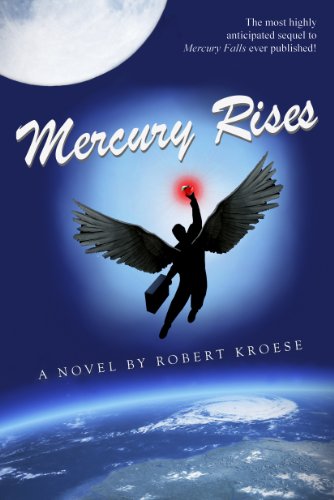
Review - Mercury Rises

Mercury is up to his old
tricks in "Mercury Rises"
A few short years ago, Robert Kroese self-published his book, Mercury Falls. Though it took a little time and a lot of effort on Kroese's part, it became a breakaway hit, garnering the attention of Amazon Encore, who later published it under their banner. Today, Kroese revisits his eccentric characters in the follow up book, Mercury Rises.


In Mercury Rises, Kroese gives us a little insight into the past of his titular character, Mercury. An angel who doesn't quite feel up to snuff to perform angelic duties, Mercury is paired with the Babylonian goddess, Tiamat, and tasked to keep an eye on her and her plan to expand the kingdom of Babylon.


The glimpses of Mercury's past are interspersed with events happening currently, in which Christine Temetri, who helped Mercury to stop the Apocalypse in Falls, gets tangles tangled in yet another plot to destroy the world. Only this time, the bringer of the Apocalypse is billionaire media-mogul Horace Finch. Rises also introduces a new character, FBI agent Jacob Slater, who managed to get himself mixed up in the end-of-the-world plot in much the same way as Christine; completely by accident.


Mercury Rises features much of the same tongue-in0cheek humor that Kroese exhibited in the first novel. Mercury continues to make his droll remarks concerning his cohorts and his situations, which, in themselves, are outrageously hilarious. One particular situation that springs to mind involves a naked, drunk Noah (yes, that Noah) and a rather lurid puppet show. So many times I had to explain to my fiancee exactly why I suddenly broke out into a deep belly-laugh that I had to start reading in the other room.


As the second book in a proposed trilogy, Mercury Rises stands alone quite well. Granted, it would be in readers' best interests to read Falls first, if for no other reason than as a source of amusement. But Rises holds a well-told story that isn't too continuity-heavy. Mercury Rises is for anyone who is a fan of religious fiction that doesn't take itself too seriously. Or, I should say, "at all seriously". If you enjoyed Mercury Falls, or if you have a sense of humor, then Mercury Rises is a must. I cannot wait for the final book in the series and the further adventures of Christine and Mercury.


Mercury Rises is available beginning today, in both paperback or as an e-book. For an added bonus, there is a short-story available for free, called Mercury Swings. While you're over at Amazon picking up Mercury Rises, you may as well toss Swings in your cart as well. Like I said, it's free.

1/23/2010

Witch and Wizard by James Patterson

A couple weeks ago, my girlfriend decided to pick up James Patterson’s new novel, Witch and Wizard on a whim. She finished it in a matter of two days and, since I had nothing to do, I picked it up to read.

In a way, I wish I hadn’t.

From the very beginning I had a difficult time figuring out if Patterson is making fun of the other magic-themed books out there, such as the Harry Potter series, or if he is trying to cash in on the phenomenon with no clue on how to go about doing that. Having Patterson’s name on the cover lent it some credence and I truly believed that it would be good. But after reading the first couple of chapters, I had a difficult time believing that Patterson wrote it.

OK. Get ready for some angry spoilers.

The book starts In Media Res with the Allgood family (seriously? That’s your symbolism?) about to be executed for the crime of being a wizarding family. Patterson then takes the time to flashback to the events that brought his characters to this situation. This wouldn’t be so bad if it weren’t for the fact that the ending had absolutely nothing to do with this beginning. Yes, Patterson eventually revisits this point in time, despite having skipped over a couple years from the end of the narrative. However, when he does return to the execution scene, he decides to give the reader a life lesson instead of a story, as if he suddenly changed his name to Aesop.

The second major flaw with Witch and Wizard is that it is told from two perspectives. The narration cuts between the brother/sister team of Whit and Wisty. Sadly, they both sound exactly the same. Patterson must have realized this at some point in his writing process because he chose to designate each chapter by its narrator. I couldn’t help but to think of how incredibly lame this made him seem. Patterson’s dialogue is also ridiculous. Unless teenage girls in the 21st century still use the phrase “far out.”

Patterson introduces characters without giving us any reason to care for or revile them. One example of this is the Byron character, who is clearly an antagonist, but later goes on to help Whit and Wisty. His motivation for changing sides was nothing more than being changed into a weasel, which makes the reader leery of his intentions, until they realize that Patterson hasn’t put anything else forward to show that he is actually a bad guy, other than Whit and Wisty not liking him. And this type of characterization plays out with all of the secondary characters, making the betrayal of the siblings later in the novel by someone they trusted completely not shocking.

If Patterson is trying to create a new magical series to cash in on the genre’s popularity, which is all this book feels like, then he needs to figure out how to do it properly. I doubt he is going to open himself up to new readers if he insists on writing as if they are morons, as he has done in Witch and Wizard. I do believe that the premise of the novel could have been good, but his execution is insulting. He blurs over plot points and instead concentrates his efforts on making up a new, “witty” language to separate his characters from the hundreds of other similar books out there. I would have liked to have some more backstory on how the New Order became to be so powerful, but all the reader is given is that they were elected into power. Why does The One Who Is The One have the abilities that he does, and why is he persecuting magical beings when it seems like he, himself, is magical? We get none of these answers, Instead, Patterson makes a huge production of events that the reader has realized fifty chapters earlier (“You mean that magical drumstick is really a magic wand? And that magical book is really a magical book? Wow, Mr. Patterson, I would never have understood that without your needlessly sentimental ending!”)

Now, I know that there is nothing I can say about Witch and Wizard that will affect its sales in any way. Hell, James Patterson could bind his used toilet paper between a hardcover and it will spend at least 14 weeks on the New York Times Best Sellers list. Like I said earlier, the only way this book can be enjoyed is if you take it to be farcical rather than serious. Sadly, with the tagline on the dust jacket that reads “this is the story I was born to tell,” I don’t think Patterson meant it that way. I just wish he had had more respect for his audience and for the genre writers that came before him before sitting down to tell this story. The public is, clearly, more intelligent than he gives them credit for. A word of advice for Mr. Patterson; stick to Alex Cross. You’ve got a winning formula there.

8/21/2009

Mary Jane: A Story of Teenage Angst and Superheroes

I recently finished reading Mary Jane by Judith O’Brien, and I have to say it was pretty good. Now, before you start wondering if I’m really a 13 year old girl who is pretending to be a grown man, allow me to argue my point. (And in my defense, it was on my bookshelf for quite awhile, after my girlfriend bought it at Midtown Comics in Manhattan two years ago.)

The novel tells the story of a young Mary Jane, and the troubles she goes through. Her father walks out on her and her mother, leaving them to fend for themselves. Because of a lack of a steady income, Mary Jane and her mother have to move from apartment to apartment, and Mary Jane from school to school. She leaves her beloved Bradford Academy and all of her friends, including a gangly, awkward kid who partnered with her on the science fair, a kid named Peter Parker. Seeing Peter’s family life, and his interaction with his parents, makes her yearn for a normal home life. That is, until the day Peter’s parents are killed in a plane crash, and his aunt and uncle move in to raise him. They cannot afford to send him to Bradford anymore, and place Peter in public school, separating him from Mary Jane.

Years go by, and due to the Watson’s transient lifestyle, Mary Jane ends up attending the same school as her childhood friend. They begin to get to know each other again, but Peter is still the weird kid, picked on by everyone else, and MJ is warned that being friends with Peter can ruin her reputation. She heeds this advice, but soon Peter starts to change, and she, and all of the girls in the school, begin to see Peter less of a nerd and more of a sexual God.

Mary Jane deals with a lot of issues that a normal teenager deals with, such as being accepted by her peers and dealing with her own self-image. But, she also is introduced to some topics that are a little more abnormal, like her friend’s father giving the entire class a sports drink laced with a highly addictive performance enhancer.

Though Mary Jane was written for younger audiences, it really captures the essence of how it is like to be a teenager. The anxiety of being a teenager is almost tangible, especially when Mary Jane starts dealing with her weight issues and takes drastic measures to improve her self. Her diary entries are realistic, as well as her inner monologue. The dialogue is a little cheesy in the way the teenagers speak to each other, but in many cases, that was intentional. In others, well, I didn’t think teenagers actually spoke like that.

I also have to commend O’Brien on the way she handled the appearance of Spider-Man, one of the driving forces in Mary Jane’s life. In every other incantation of Spider-Man, we get the story from peter Parker’s perspective. But since this is Mary Jane’s story, we get to look at it a different way. When Spider-Man hits the scene, taking on the Demon Knife Master for a prize of $1,000 a minute at the Wrestle Cage Rage match, we watch as Mary Jane recognizes a few acrobatic moves she herself taught Peter Parker, and begins to wonder if it can be possible. When Spider-Man saves her from being hit by a car, she examines the sound of his voice, wondering again, and even outright asking, if Peter Parker is Spider-Man. And the way she is kept in the dark, when she discovers that the two cannot be the same person, is believable, a simple cover but plausible nonetheless.

My one gripe, however, is the show-and-tell Peter gives Mary Jane when he discovers that he has changed. The day after getting bitten by the radioactive spider (though they don’t make it clear it the spider was in fact radioactive) Peter shows off his new abilities to the entire school, literally running circles around the previously more athletic kids. Later that day, he tells Mary Jane about how he doesn’t need his thick glasses anymore, he begins showing her his new muscles, and she starts touching her abs and biceps. Though this idea of showing off to his peers is a true teenage attribute, I was a little disappointed in it. The Spider-Man that I know knew that this new powers would make him an almost instant celebrity in his school, but he decides to keep it a secret anyway. With great power comes great responsibility, right? And flaunting that power is not responsible. So to see Peter Parker act in so flippant a manner was slightly irritating, but I managed to get over it.

One other aspect in the novel is the illustrations. No Marvel book would be complete without a few pictures. Mary Jane isn’t overdone with pictures, but what it has are amazing. Done by the great Mike Mayhew, the illustrations manage to capture the essence of the novel’s young stars, and place them in their everyday situations. Peter being ostracized by his peers, Mary Jane studying her body, and Peter and Mary Jane sharing an intimate moment are all snapshots that Mayhew gives the reader. And the emotion on their faces is so precise that you can almost understand the story completely without reading a single word.

Though it may be strange for a guy like me to read a book aimed at teenage girls, I am proud to say that I did. Being the fan of Spider-Man that I am, and with Mary Jane being such an important part of the Spider-Man myth, I felt that it was important for me to read this novel, so that I can see another author’s take on both characters. I would recommend it to anyone who enjoys Spider-Man like I do. It is a short novel, only about 200 pages, and a quick read. But it is worth it to the true fans for a new take on the story they know so well.

And now that I am done with the first novel, I will be moving onto the second very shortly.

7/09/2009

X-Men and Philosophy

The other day I purchased X-Men and Philosophy, another outstanding addition to the popular book series that finds philosophical meaning in many of the pop culture items that surround us, such as Buffy the Vampire Slayer, The Sopranos, and Batman. Having read a few of these, one of which being the Super Heroes and Philosophy, I decided that a book like this concentrating on my favorite group of heroes would be a good way to pass the time.

For the most part, the essays in the book are really good. One of them concerns the character of Wolverine and the idea of personal Identity. Another involves Jean Grey and the morality of suicide. The majority of the essays is well-written and thought provoking. However, there is one that made me cringe.

The essay is called X-Women and X-istence and it was written by Rebecca Housel. In it, she discusses the existentialism in a few of the female mutants. The essay starts off in a logical sense, discussing the existence of Jean Grey as it relates to her essence, much of the way Jean Paul Sartre described. Housel goes on the talk about Rachel Summers and Wanda Maximoff and everything seems to go smoothly, though I am beginning to see some flaws in her arguments. It wasn’t until she began to dissect Mystique that her credibility really plummeted. Housel’s rationale of who Mystique really is concerning her character is so riddled with clichés that it becomes almost unreadable. Besides the fact that none of her arguments are accompanied by defining examples, her writing turns really sloppy. Yes, Mystique can “slither out of bad situations” and “live to fight another day,” but what in her past has shown that? I can name many examples, but I am also a comic book fanatic. This book should not have been written for people like me, but for people who know very little about the characters, and thus educate them on the X-Men. I can, and have, have conversations just like this one with others who share my knowledge, so to write to someone like me is senseless. By not providing proof to her claims, Housel comes off as a two-bit writer who doesn’t know her subject well enough.

She describes Mystique as a ‘person’ who makes “bad faith” decisions. The idea of a “bad faith” decision comes from Sartre, and it implies that a person will deceive themselves when it comes to the truth. That person knows the truth, but ignores it. What Housel doesn’t realize about Mystique is that she believes what she knows, so there is no self-deception involved. Mystique firmly believes that her actions are justified, despite what others tell her. The X-Men are wrong for fighting for the weaker humans, not Mystique for fighting for herself. She doesn’t do the things she does to benefit mutants; she does them to benefit herself. A better philosophical analogy for Mystique would be to compare her to Ayn Rand and her justification of selfishness. The hero of Rand’s novel Atlas Shrugged, John Galt, exemplifies the idea of selfishness, and that the idea of self-sacrifice is illogical. There is no “bad faith” in Mystique, but there is plenty of self-serving goals.

As I kept reading the essay, I got more annoyed when Housel came to Rogue and Shadowcat. These are two of my favorite X-Women, so her two-dimensional descriptions of these two characters damn near infuriated me. Rogue, in the writers mind, is comparable to Sisyphus, the mythological hero who must roll a boulder up a hill everyday, only to have it roll back down, and repeat the process for eternity. I had to scratch my head at this analogy. Yes, I agree that Rogue’s power is a curse and not a blessing. She cannot enjoy the touch of another human being. But I hardly would compare her suffering to Sisyphus. I wouldn’t look at Rogue in terms of existentialism; the wisest philosophers in the past could not have considered a creature such as Rogue, so likely nothing has been spoken about her condition. Rogue can be described in terms of Karl Jung’s archetypes. I would think Rogue fits more along the lines of The Wanderer. This webpage gives a list of archetypes used for characters, and it describes the wanderer as “an invisible barrier stands between the mind of Man and the Mind of God.” If we consider Rogue’s power as the invisible barrier and human contact as being the ‘Mind of God’ this would be an accurate description. Granted I understand that Jung’s theory of archetypes is psychological, not philosophical, but my comparison still holds.

Shadowcat is also given a half-assed philosophical treatment. Housel concentrates on the Days Of Future Past storyline, in which a future Kate Pryde sends her consciousness into the mind of a young Kitty Pryde, in order to stop an event that causes the downfall of mutant kind. She describes Kitty in a way that Jose Ortega y Gasset calls a ‘substantial emigrant on a pilgrimage of being.” As Housel explains, this idea is that people have no set nature at birth. It is through the events of life that we come to be the people we are. While this could be said of the older Kate Pryde, who had lived a full life and seen much destruction in her time, this is inaccurate of Kitty. True, the young girl is still in flux and her sense of self is still being shaped. But the author seems to focus on the older Kate when she makes her distinction, which is wrong. Kate Pryde sacrificed herself and her future by going to the past to change things. She did not want to see the events that made the hellish world she lived in come to pass, and by changing the past, she would alter her own perceptions and the events that shaped her. She would not have had to live through the imprisonment or destruction of her friends and colleagues. She would have had the chance to find a husband and start a family in peace. While Ortega’s ideal may hold true for Kitty and Kate Pryde, it becomes inaccurate to take the personality of Kate Pryde that we know, and apply it to Kitty.

While I greatly enjoy the idea behind the book of X-Men and Philosophy, I feel this essay is a major fault with the book. It will not keep me from reading on, nor will it keep me from purchasing other books in the same vein as this one in the future. But I think the writers and editors should have done a better job of conveying their opinions, as well as staying true to the ideas of the characters they write about. Of the eight or nine characters talked about in the book so far, these were the most off base. Thankfully, most of the philosophers understand their subjects. It is just a shame that Ms. Housel failed to follow the lead of her peers.

6/02/2009

His Dark Materials

A few weeks ago, my friend lent me The Golden Compass, as I had asked him about them in the past. He gave me a little bit of background about it, that the author is an Atheist and there are very anti-religious undertones to the entire series. Being an Atheist myself, I decided that this was awesome and took the book home.

Two days later I was in Borders purchasing The Subtle Knife, because I couldn't wait to see my friend again to borrow his copy.

Last night I finished The Amber Spyglass, the last book in the His Dark Materials series. All I have to say is, Wow.

I first saw the movie The Golden Compass shortly after it came out on DVD. I thought it was good, but that was only due to the fact that I hadn't yet read the book. After reading the book I can say that the film was shortsighted in comparison, leaving out the most important parts.

I never expected the three books to be as put together so well as they had been. Philip Pullman's style of writing seems clunky at first, but as you go deeper into it, you begin to enjoy the nuances of his word choice. His descriptions of the worlds and the characters gives you enough so that you form an almost perfect picture in your mind, without bogging the novel down with endless descriptions.

And the story... About halfway through The Golden Compass, I was having trouble finding the anti-religious sentiment that had caused such as uproar when the movie was released. But by the end of it, that notion was dead center, staring me in the face. And what a notion it was. I was shocked by how bold Pullman made the Lord Asriel character, being willing to undertake a feat like what he had proposed to do.

The Subtle Knife was equally awesome in it's complexities and plot development. I don't want to go into too much detail about the story because it's really something you need to read in order to appreciate it.

It's really a shame that Americans are so uptight about their religions that they would be willing to stifle anything that disagrees with it. But I suppose that is the definition of ignorance. Despite the fact that Philip Pullman is a devout Atheist, his stories are well crafted and well thought out. The entire time I was reading books 2 and 3, I kept saying to myself that it's such a shame they would never be adapted into films. It's unfortunate that people like this feel the need to strike down anything that goes against their religion, which is bullshit in itself. From what they preach, god endowed all of us with free will and the ability to think for ourselves. Unfortunately, the zealots of those religions that follow this same god decide that they know better than we do and shove their opinions down our throats. That's a little like undermining the will of god, is it not?

Every protest I've read online states that Philip Pullman and New Line Cinema want to "trick" you into taking your children to see the movie and buying them the books. Are you serious? As a grown-up and a parent, you are so easily swayed by what others tell you to do that you blindly follow their lead? Oh, well, I guess that's true, otherwise you wouldn't be a Christian, would you?

His Dark Materials is a shining example of literature that could have translated very well onto the big screen. However, due to the bitching and whining and breath-holding of the zealots in the world (most of whom I can guarantee are Americans) that will never come to fruition.

And it's a shame really.

Just watch the shit storm I will unleash when they try to turn Left Behind into a movie.
Related Posts Plugin for WordPress, Blogger...